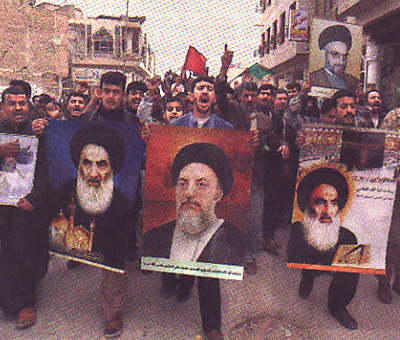
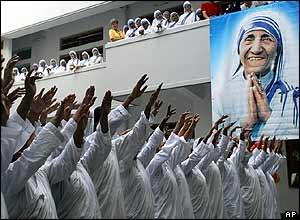
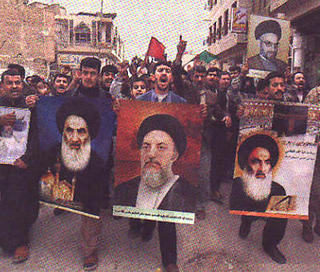
 Guerilla marketers try to raise public awarenes about the "Beards Gone Wild" video series
Its not every day I get to quote President Bush on this blog, but this is Iraq Week at WisdomWeasel so without much further ado, from March 5 of this year:
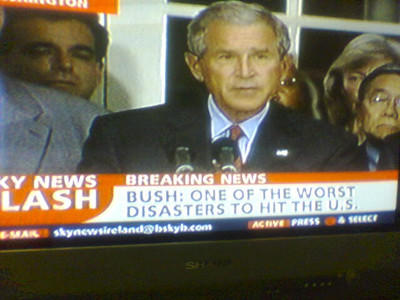
"Freedom is the birthright and deep desire of every human soul, and spreading freedom's blessings is the calling of our time. And when freedom and democracy take root in the Middle East, America and the world will be safer and more peaceful."I think we can all agree that the first sentence is an outstanding sentiment, one indeed worth fighting and dying for. Fight with guns, fight with words, fight by refusing to give up your seat on a city bus because of your color- whatever your weapon of choice is, I think we all hope that if called upon we will fight for that ideal. The second sentence, eh, not so good. The first clause will undoubtedly come to pass in some parts of the middle east. As for the second clause, alas we have no evidence that this is true, and quite a few indicators that the opposite will be the case.
This is quite mind-bending stuff, not least for your humble correspondent, so lets revive the tried-and-tested Q&A format to try and bring some clarity to the issue.
Q. What the hell are you talking about? Iraq was a dictatorship- now they have had elections and are going to have a constitutional referendum. Surely that is the birth of a democracy?A. I'm not disputing the democracy part- I'm disputing the "America and the world will be safer and more peaceful" part.
Q. Why is that?A. As we all know, Iraq is an artificial construct, carved from the sands of the Ottoman empire based on a Cambridge educated British civil servant's concept of a long-lost Mesopotamia that ignored cultural and ethnic realities on the ground in order to both compensate an Arab Hasimite prince who helped out in the First World War and to ensure British hegemony in an area considered vital to interests in India and (whisper it) rich in that fossil fuel stuff for the Royal Navy's new oil fired warships. Fast forward a bit; Iraq has been a dictatorship for most of its existence, is flush with oil resources (if not oil wealth a la Kuwait: I seem to remember an invasion in 1990
about that*), and divided into ethnic and sectarian camps. What we are trying to do in effect is parachute a fully functioning democracy into a nation whose component parts are seething with pent up religious feeling, ethnic nationalism, fears of loss of privilege, and so on. Its like we decided to encourage national elections in Bosnia during the siege of Sarajevo.
Q. So Iraq shouldn't be encouraged to become a democracy?A. I'm not suggesting that. I'm just saying that we had better be ready for the consequences should it come to pass.
Q. What consequences?A. Worst case senario is civil war. Or rather, an escalation of the ongoing, undeclared, civil war (sidebar- the conflict in Iraq is war cubed; the coalition and the Iraqi government fighting the insurgents, sectarian attacks on the Shia by Sunni groups, and internicine fighting among the Shia groups. Three wars at once is amazingly screwed up in a country where major combat operations were declared over in 2003). Second worst is a country dominated by a religious Shia majority whose leadership has closer ties to Tehran than to Washington with a seething Sunni minority and a Kurdish population more interested in creating their own defacto country than in being a team player. Third worst is a vaguely functional democracy with constitutionally reserved powers for different ethnic groups serving as a cheap band aid over a festering wounded society. We have seen the last one before in the middle east- it was called Lebanon.
Q. Jesus- what a little ray of sunshine you are. Are you one of those racists who believe Arabs can't have democracy?A. First- to call the population of Iraq "arabs" is about as sensible as calling the population of the United States "europeans". That aside, to allow a functioning democracy to develop you need a sense of national identity, and a population that rejects extemist answers. In Lebanon you didn't have the first- you had ethno-religious identification. In Algeria (the other
predominantly Arab muslim country to try democracy) you didn't have the second, at least not in the eyes of the ruling FLN when they saw themselves losing the election to Islamists. In Iraq you have a perfect storm- a majority population who see themselves as Shia first, Iraqi second and who are trending towards a deeply religious state who as mentioned above would have more in common with their co-religionists in Iran than with any western concept of civil society.
Q. You keep banging on about the Shia- are Iraqis uniquely suceptible to the lure of sectarian government?A. A look at the rise of the Democratic Unionist Party in Northern Ireland would tell you no (nor the influence or desires of the christian right in the United States). I think the reason Iraqi Shias are looking to the more radical Islamic parties like Muqtada al-Sadr's and the Supreme Council for Islamic Revolution in Iraq (SCIRI) is similar to the reason East Germany wound up with a communist government after 1945. One; Newton's Third Law of Motion as applied to politics- every action has an equal and opposite reaction. After decades of repression by Saddam and the Sunni minority, the end of Hussein's regime was bound to see the majority flock to those who promised the most extreme revision of the previous situation. Two; an influential foreign player with a carefully groomed leadership ready to go as soon as the old regime fell. For the Soviet Union, read Iran. Three: the presence of unreconciled Baathists and Sunni xenophobes running amok with guns sort of induces a collective protection mentality in the Shia. Fourth, those who oppose the extremists in their own midst risk having their families and themselves killed.
Q. But can't the American lead coalition bang heads and get everyone around the table?A. The American lead coalition can't even leave their firebases without getting their convoys attacked. Big dog politics then dictates that the American coalition then has to punish the ungrateful natives- hence tanks crashing through prisons, and the flattening of Falujah, Tal Afar, etc. Also, any hint of a solution imposed from outside has as much chance of being successful as a Craig Hansen breaking ball.
Q. Alright smart ass, what do you suggest?A. Build a big wall around Iraq? Its beyond me. There are a million more variables to consider on this subject, but its begining to fry my brain. If any of this has struck a chord with you check out the following links for more information. And ask any questions you like- I have left so much out of this post that the comments section might be a useful forum for ironing out inconsistencies or confusion.
Who Are The Insurgents? (BBC)The Iraqi Draft Constiution- Is It Flawed? (BBC)Professor Juan Cole- One of The Most Interesting American Thinkers on the Middle East.
(*If you follow that link you'll read about Saddam's attempt to aquire krytron triggers for nukes, an operation that was in part broken up by British Customs agents. We had a mock krytron trigger used in the customs sting on the tank of the downstairs toilet at my parents' home, as my mother was part of the
HM Customs Solictors Office prosecution team that took on that case (and the Arms-to-Iraq case that lead to the
Scott Inquiry).